
Number of children


Frontline observations

Within IntelliGrade , images and videos are supplemented with descriptive metadata, including details such as a child’s age and the nature of the abuse depicted. In the past, when more than one child appeared in an image, only the details of the youngest child could be captured.

Following enhancements to IntelliGrade funded by Nominet’s Countering Online Harms programme, it is now possible to record the age and sex of every child visible in a single image. This new 'Multichild' capability was introduced on 1 January 2024.

Individual children recorded since Jan 2024

958,304

Capturing detailed intelligence on each victim shown in the criminal images we assess enables us to form a more precise picture of the scale of abuse, including the number of victims involved and their age and sex.

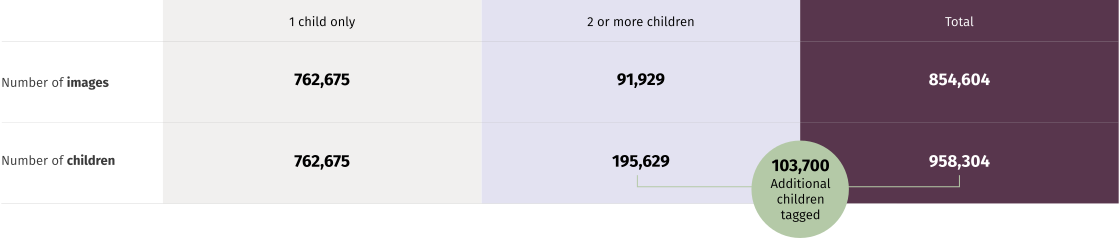
The table below outlines the volume of images reviewed since the launch of the Multichild format, with videos and multi-image collages (grids) excluded.

It details how many images included only one child versus those showing two or more children together, and also breaks down the overall count of children observed, specifying whether they appeared alone or in the presence of other children.

In 2025, 370,001 children were recorded in images; 39,203 of these children were only recorded thanks to the Multichild data collection capability.

This chart illustrates that since Multichild became available in January 2024, we have identified 958,304 children across 854,604 images depicting child sexual abuse. These are not all unique children as we will sometimes see the same victims across different images. 

103,700 of these children would not have been recorded without this new capability. 

IWF Image Classification Assessor
Frontline observations

Some readers may find the following descriptions distressing, please feel free to skip this section.

The number of children we see in an image or video can range from one child up to large groups. These may be the child’s friends or family members, but in most cases it’s impossible to tell. It is extremely important to us as a team that every single child present in an image of sexual abuse is accounted for in our data. 

Sometimes several children appear to be an audience to the abuse of one, or we may see an older child seemingly engaging a younger child in sexual activity. This abuse may take place in ‘self-generated’ imagery within a domestic setting, or it could be staged at a studio, with props, costumes and custom backdrops – almost a ‘production line’ of child sexual abuse material, professionally branded and created for commercial distribution.