Draft status
In 2025, we continue to publish findings on the volume of URLs actioned per domain and the number of unique domains hosting child sexual abuse material.
Our analysis covers distribution across classification groups, including host country, abused top-level domains (TLDs), commerciality, and the return of content after takedown and suspension actions.
A small number of websites hosting large volumes of child sexual abuse material can rapidly place a country in our top 10 by URL volume. While this metric is important, the number of unique websites hosting such material provides a different perspective, as high report volumes may stem from one or two sites rather than widespread activity across a country.
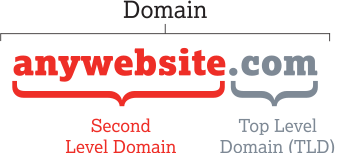
The diagram below illustrates the domain naming conventions we use.
The chart above shows the number of unique domains hosted in each country. Each domain is counted only once, regardless of how many actions were taken against it during the year. If a domain changed hosting location during the year, it is counted for each country where it was hosted.
The US, Netherlands, and Russian Federation, continue to attract the highest volume of domains displaying child sexual abuse, with each country remaining in the top three based on overall hosting volume.
The identified .onion domains cannot be linked to a specific hosting country and are included for transparency. The .onion domain is a special-use top-level domain for anonymous onion services.
The overall number of unique domains saw an increase in 2024. However, it is not possible to confirm whether the overall global availability of domains has increased without comprehensive data from non-IWF sources, such as other hotlines.
For clarity, the diagram below sets out the domain naming conventions used throughout this report.
GRAPH OF DOMAINS OVER THE YEARS TO BE ADDED
This analysis looks at the distribution of child sexual abuse URLs found to be operating under each website’s top-level domain (TLD). Each recorded URL may relate to a single image or multiple images of child sexual abuse identified on URLs operating under a specified TLD.
The abuse of TLDs can be further broken down as follows:
For the calculation of volumes on a URL, webpage reports for www.anywebsite.tld, www.anywebsite.tld/forum/page1 and www.anywebsite.tld/images/girls.html would be counted as three separate instances of child sexual abuse attributable to the identified TLD.
Our Domain Alerts support Members in the domain registration sector by reducing and preventing abuse of their services. They provide early warnings of detected abuse and help stop criminals from re-registering sites with a known child sexual abuse history on other TLDs.
Tracking the use of second-level domains as a distinct category provides further insight into how different domain strings are registered and used under different top-level domains (TLDs) in both commercial and non-commercial contexts.
Monitoring domain strings helps identify when bad actors repeatedly register popular names. This insight also enables registries and service providers to reduce the risk of sites being deliberately created for commercial child sexual abuse.
“www.anysite[.tld]” – in this example, the [anysite] name or ‘string’ is classed as the second-level domain of the website address.
The largest yearly increases were identified on the gTLD .shop and ccTLD .cc (Cocos – Keeling Islands) TLDs.
Second-level domains created for the commercial distribution of child sexual abuse material are a serious concern, representing deliberate abuse of the Domain Name System (DNS). When registrars are alerted to such sites, we encourage investigating other domains registered by the same entity. This can uncover additional sites for IWF review under a ‘special escalations’ process, designed to assess potential links across a registrant’s domain portfolio. Taking this proactive approach helps disrupt criminal abuse by identifying and suspending previously unknown sites.
We identified 719 instances of the .cc ccTLD in 2024 making it the most abused TLD by volume of unique dedicated commercial second-level domains, representing 28% of the overall global total (193% increase on what we saw in 2023).
The .cfd gTLD was seen for the first time in the top ten since recording this information, with 52 domains identified, accounting for 2% of the overall global total (767% increase on what we saw in 2023).
In total, 2,554 unique second-level domains were uncovered and actioned, and in every instance the websites openly displayed images and videos of child sexual abuse on their homepage. In 2023 we reported 3,143 domains abused in this way, so this represents a welcome reduction of 19%.
Gaining insight into how second-level TLD's are registered and exploited for the commercial distribution of child sexual abuse material allows us to work with registries, registrars, hosts, filtering providers, search engines, and other partners to reduce opportunities for criminal activity. Every successful detection and prevention ultimately supports victims and survivors of abuse.